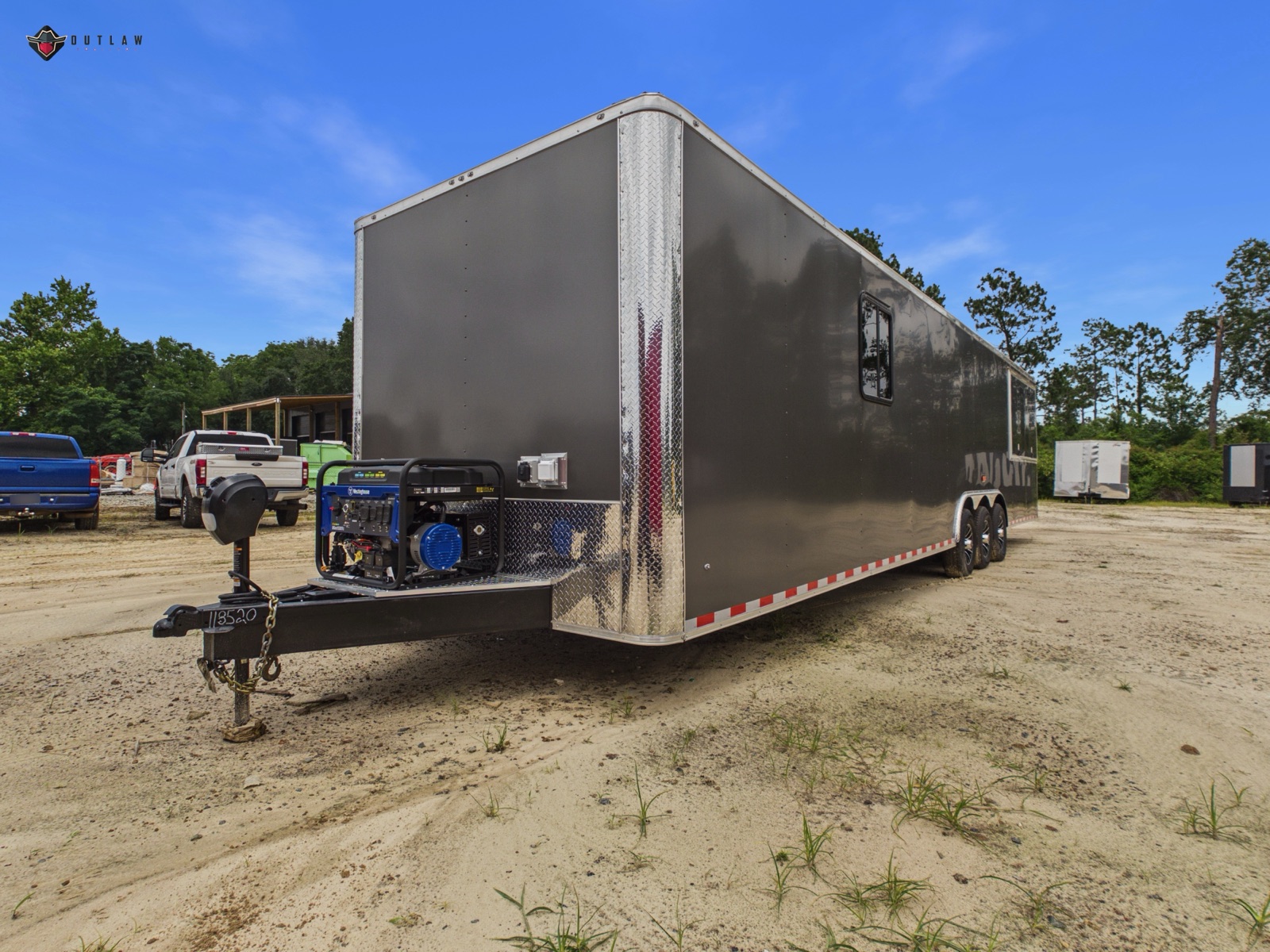
Hurricane Season: What to Do With a Trailer Before a Storm
The two things people get wrong are leaving it empty and leaving it broadside to the wind. Both are avoidable.
August 24, 2026 · 5 min read
Everyone from the Big Bend to the Georgia coast deals with storm season, and a trailer sits awkwardly in that planning. It is valuable, it is exposed, and it is large enough that wind treats it as a structure rather than as a vehicle.
The physics worth understanding
An enclosed cargo trailer presents a large flat side to the wind and weighs comparatively little when empty. That combination is exactly what you would design if you wanted something to move in a gust. Loaded, the same trailer is far more stable — mass is the entire difference.
So the instinct to empty a trailer before a storm, to protect the contents, often makes the trailer itself more dangerous. Think about the whole picture rather than only the cargo.
Before the season, not during it
- 1**Photograph the trailer**, inside and out, including the VIN plate. Do this once a year. It is what turns an insurance claim into a straightforward one.
- 2**Confirm your insurance actually covers it** and understand what for. Many owners assume a trailer is covered under an auto policy and find otherwise.
- 3**Keep the title and paperwork somewhere other than the trailer** — a fireproof box or a scan in cloud storage.
- 4**Decide in advance where it would go.** The time to identify a sheltered location is not while a cone of uncertainty is over your county.
- 5**Service the bearings and check the tyres.** A trailer you cannot safely move at short notice is a trailer that stays put.
As a storm approaches
- **Move it if you sensibly can** — into a barn or shop, or out of the projected track entirely. This is far and away the best option.
- **If it stays, weight it down.** Load it with something heavy and secure, low and centred. Do not leave it empty.
- **Point the nose into the expected wind.** Presenting the smallest face to the strongest wind is the whole idea.
- **Chock the wheels properly** and lower the jack onto a solid pad.
- **Park it away from trees, power lines and anything that could fall on it.**
- **Do not park it where it would block access** if it does move, or where it could roll into a structure.
- **Close and lock everything**, and check the roof vents are shut.
Afterwards
Before you tow it anywhere, walk it. Check for structural damage, check the tyres for debris and cuts, check the lights and the wiring, and look at the roof seams — wind-driven rain finds them. If the trailer has moved at all, inspect the coupler and the frame around it carefully before hitching.
And if it was used for storm work afterwards, which many are, rinse it thoroughly. Debris, mud and standing water in a trailer after a storm start corrosion that lasts years longer than the cleanup did.
Frequently Asked
Should I empty my trailer before a hurricane?+
Usually not, unless you are moving the trailer itself somewhere safe. An empty enclosed trailer is light and presents a large flat side to the wind, which is exactly the combination that gets one moved. Weighting it down low and centred, nose into the wind, is safer than leaving it empty.
Is a trailer covered by my auto insurance in a storm?+
Sometimes and sometimes not, and the difference matters. Many owners assume coverage carries over and discover otherwise after the fact. Call your agent before the season, confirm what is covered, and photograph the trailer annually including the VIN plate.
Ready to roll?
200+ trailers in stock in Douglas, GA. Financing for all credit types.