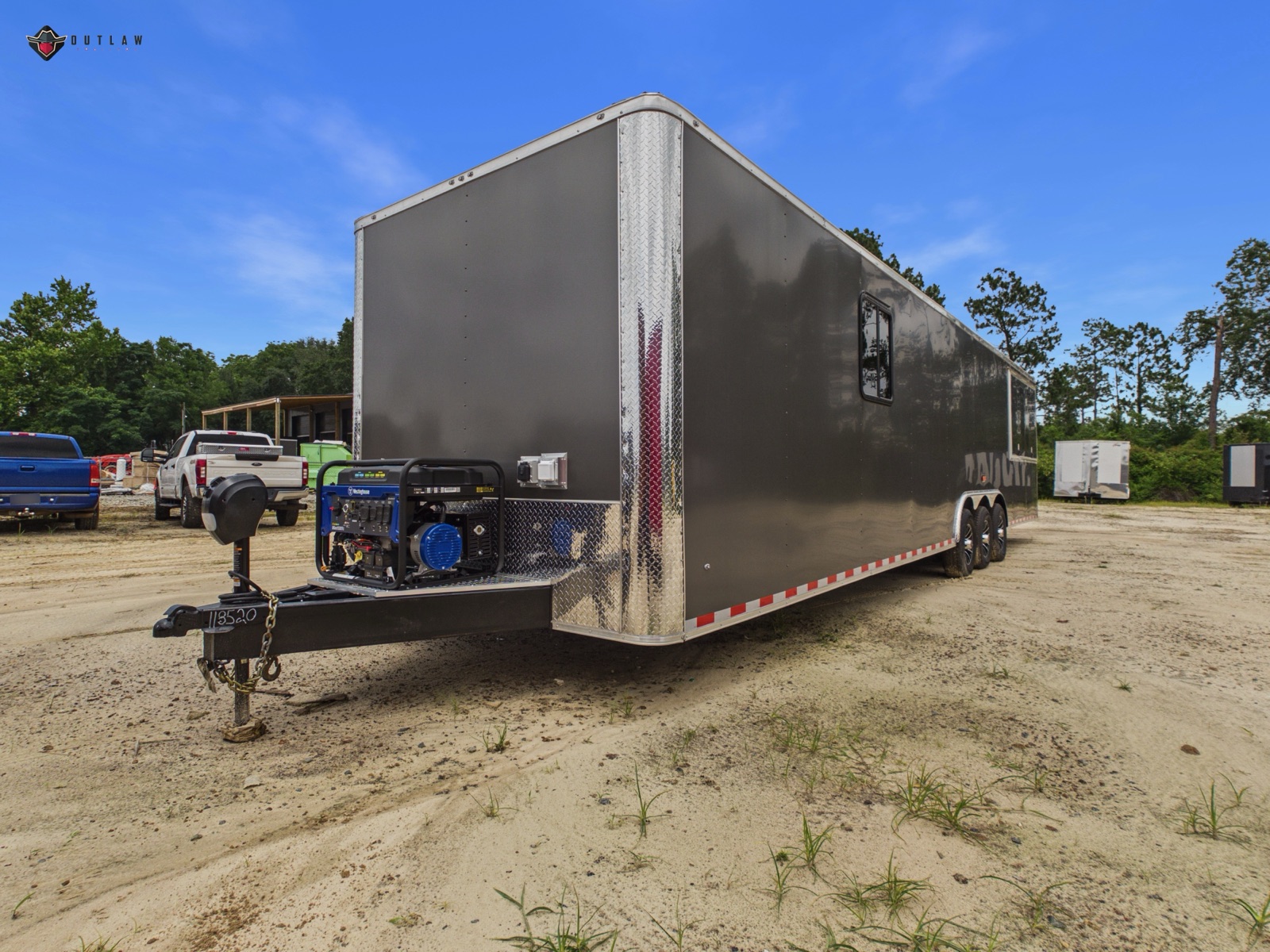
5-Wide, 6-Wide, 7-Wide or 8.5-Wide: Picking a Trailer Width
Most buyers argue about length and forget that width is the spec that decides whether the mower, the car or the pallet actually goes through the door.
September 21, 2026 · 5 min read
Every enclosed cargo trailer on our lot in Douglas falls into one of five families, and the first word in each family name is the width: 5-wide, 6-wide, 7-wide, 8.5-wide and gooseneck. Length is the number people quote on the phone, but width is the number that decides whether the thing you own goes inside. This guide walks through what each width is actually for.
Why width matters more than length
Length is easy to add. If a 14-footer is tight, a 16-footer of the same width solves it without changing how the trailer tows. Width is different. Going from 7 feet to 8.5 feet changes the axle package, the fender design, the tow-vehicle mirrors you need, and how the trailer behaves in a crosswind. It also changes the interior in a way length never does: an 8.5-wide has the fenders outside the box, so the floor is flat wall to wall. A 7-wide and narrower has wheel wells inside.
So the practical order of decisions is width first, then length, then height. Get the width wrong and no amount of length fixes it.
5-wide: the runabout
The 5-wide trailers are the smallest enclosed units we carry. They suit a single motorcycle, a small lawn setup, a market vendor with a folding table and a few totes, or someone who needs lockable weatherproof storage that a mid-size SUV can pull without drama. They are also the easiest trailer to back into a driveway. Where they fall short is anything on wheels wider than about four feet, because the wheel wells eat into the usable floor.
6-wide: the most common first trailer
A 6-wide is where most first-time buyers land, and for good reason. A 6x12 handles a one-bedroom move, a zero-turn mower with the deck folded, two motorcycles, or a detailing rig with a tank and pressure washer. It still tows easily behind a half-ton truck or a full-size SUV. The limit is the wheel wells again: a 48-inch mower deck fits between them, a 52-inch deck usually does not, and that single measurement pushes a lot of lawn crews up a size.
7-wide: the working trailer
The 7-wide family is the backbone of contractor and landscaping fleets. A 7x14 or 7x16 tandem axle gives you room for a 60-inch mower plus a walk-behind and a blower, or a full trade setup with shelving down one wall and still a clear aisle. Most of our custom work trailers start here. It is also the largest width that still feels normal behind a half-ton pickup.
8.5-wide: cars, race day and mobile businesses
The 8.5-wide lineup is the car-hauler width. A full-size car or truck fits with the doors able to open, which is the whole point. Because the fenders sit outside the box, the floor is flat from wall to wall, which is why concession builds, mobile shops and race trailers all start at 8.5 feet. The trade-off is that you are now towing something as wide as a dually, so you want a three-quarter-ton or larger tow vehicle, extended mirrors, and a bit more planning at fuel stops.
Goosenecks: when the load is the business
Goosenecks are 8.5-wide trailers with a raised front deck that couples in the truck bed. They tow more stably than a bumper-pull of the same length, and they make sense once you are regularly hauling multiple vehicles, heavy equipment or a full race program. If you are asking whether you need one, read our gooseneck vs bumper pull comparison before you decide.
A quick way to decide
- Measure the widest thing you will carry, including mirrors, deck or handlebars.
- Add at least six inches on each side for loading and tie-downs.
- If the answer is under 4 feet, look at 5-wides and 6-wides.
- If it is between 4 and 6 feet, a 7-wide is the safe choice.
- If it is a car, a truck, or anything over 6 feet, you are in the 8.5-wide family.
- Then choose the length by adding what else has to ride along.
If you are still between two widths, the answer is almost always the wider one. Nobody has ever come back to the lot wishing they had bought a narrower trailer. If you want to walk through it with a person, give us a holler or come see the lineup in Douglas.
Frequently Asked
Is an 8.5-wide trailer harder to tow than a 7-wide?+
It is wider than your tow vehicle, so you notice it more in crosswinds and at fuel stops, and you will want extended mirrors. With the right truck it is not difficult, but it is not a half-ton job for long distances.
Does width change the price much?+
Yes. Each step up in width adds material, a heavier axle package and usually a longer minimum length, so the jump from 7-wide to 8.5-wide is larger than the jump from 6-wide to 7-wide. Our shop pages list a starting point for each family.
Can I get a flat floor in a 7-wide?+
No. Any trailer 7 feet wide or narrower has the wheel wells inside the box. The 8.5-wide design moves the fenders outside, which is where the flat floor comes from.
Ready to roll?
200+ trailers in stock in Douglas, GA. Financing for all credit types.